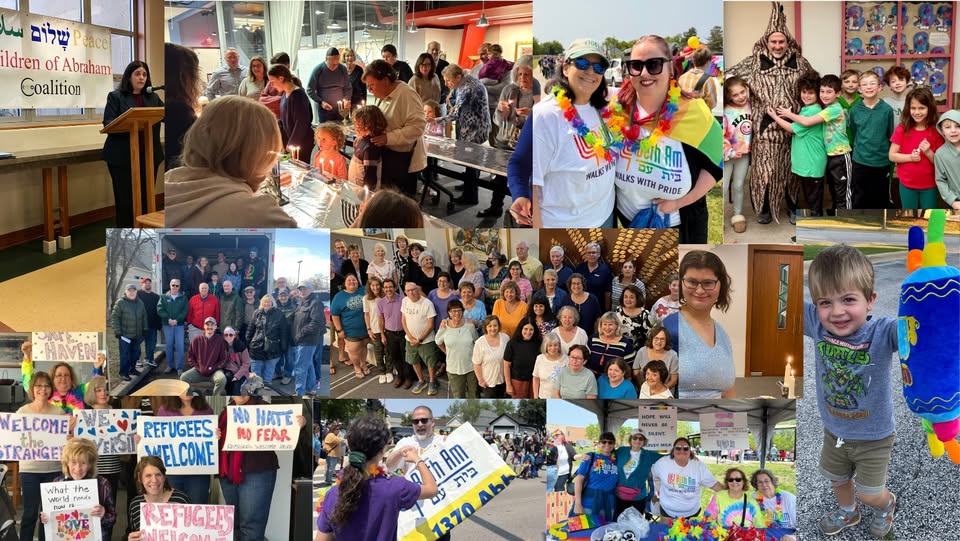
You are welcome here.
Choose Kindness • Find Joy • Repair the World
Give
A Message from Rabbi Bellows

April 19, 2026/2 Iyar 5786
Friends,
Some argue that clergy should remain above politics, speaking only to matters of personal faith. But our tradition—and, indeed, many, if not most, faith traditions—suggests otherwise. From the prophets of the Hebrew Bible to Jesus, to Mohammad, to contemporary voices, spiritual leadership has never been separate from society’s moral challenges. To speak about human dignity, justice, and moral issues of our day is not to be political—it is to be faithful. Questions of war and the ethics of “just war,” for example, are explored deeply in our rabbinic tradition.
As Rabbi Rick Jacobs, the President of the Union for Reform Judaism, writes, “Sermons that ‘speak up’ on the great moral issues of our world and our lives may address politics and policy as a means of addressing such moral issues but they are not about politics. On the contrary, they are about our Jewish values; the values we teach and the values we pass on to our children; the values that have kept us together as a people for centuries.”
Clergy are not called to endorse candidates, parties, or policies. Rather, we are called to help illuminate the moral dimensions of the choices before us. When public discourse grows harsher, when vulnerable communities are at risk, when peace and economic security are at risk, silence is not neutrality—it is absence. And for me, this sort of silence is an abdication of responsibility.
At our best, we strive to create space for thoughtful dialogue instead of division, for conversation rather than alienation or coercion. We ask enduring questions: What does our tradition demand of us? How might Torah and the wisdom of our Sages respond to the moral challenges of our time? What does our faith call us to do? While each of our answers to these questions might lead us toward different conclusions, speaking out is not optional.
The work of clergy is not to tell people what to think, but to invite them into deeper moral awareness—grounded in sacred text and anchored in tradition.
In a time when so much feels uncertain and divided, the role of clergy is not to provide simple solutions, but to help us stay rooted in what matters most. Our task is to bring the wisdom of our tradition into conversation with the world as it is—to challenge, to comfort, and to call us toward tikkun olam, repairing the brokenness. If we can do that with humility, courage, and compassion, then our voices—together—will help shape a more just future for generations to come.
L’Shalom,
Rabbi Bellows